How to make a sourdough starter with white flour
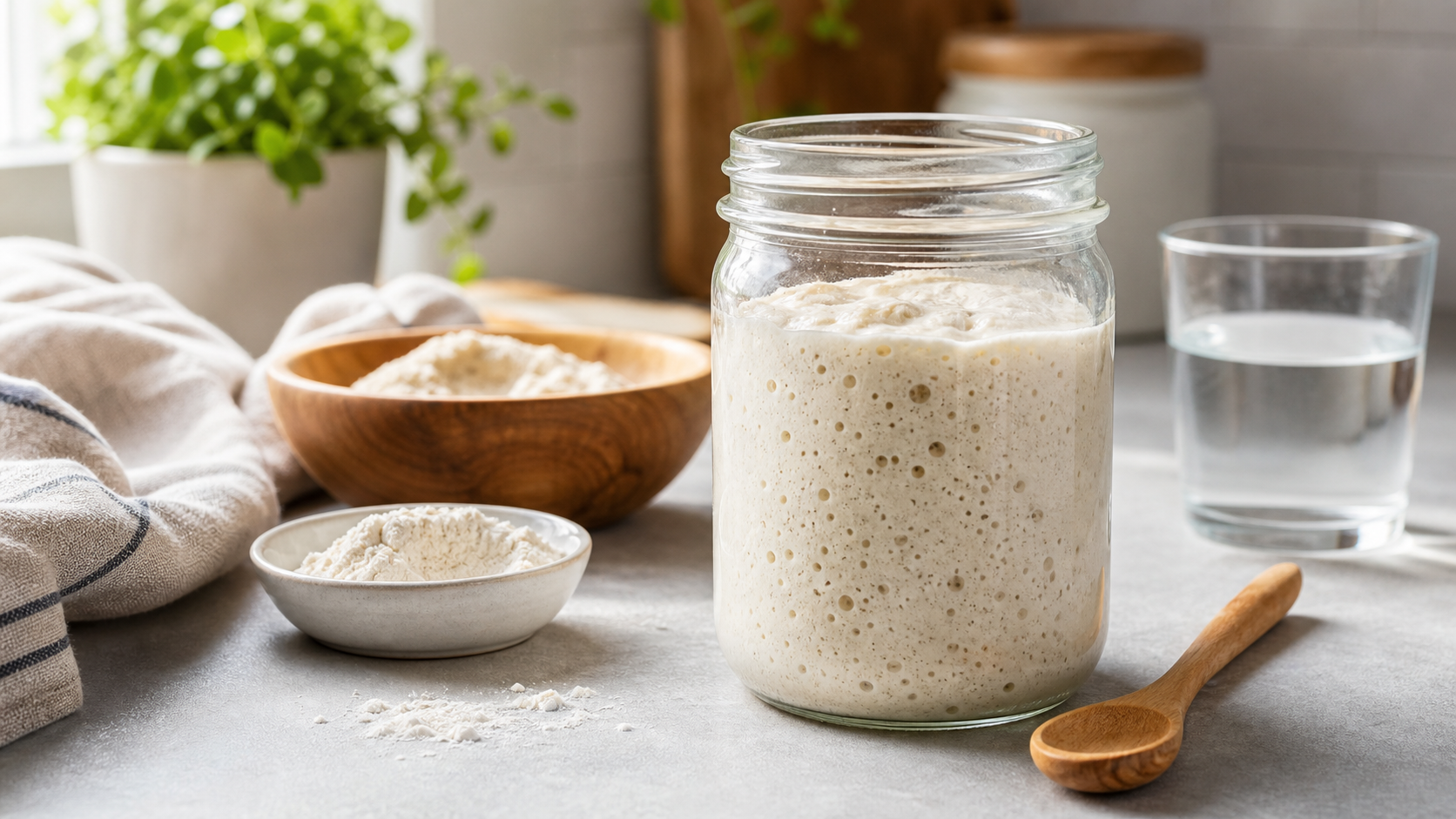
This is a simple, low-waste way to make a sourdough starter from scratch using mostly organic white flour. The idea is inspired by Bake with Jack's unfussy starter approach, but this version is written for the way I like to build and use a white-flour starter in a UK kitchen.
You do not need a huge jar, expensive kit, or mountains of discarded flour. You need a clean jar, water, organic white flour, a spoon, and patience. White flour can be a little slower than wholemeal or rye because it has fewer minerals and microbes on the bran, so give it time and keep it somewhere comfortably warm.
What you need
- A clean jar with enough room for the starter to rise.
- Organic white flour, ideally strong white or a good bread-making white flour.
- Water at room temperature.
- A spoon or small spatula.
- An elastic band or marker to track the level.
Day 1
Mix 25g organic white flour with 25g water in the jar. Stir until no dry flour remains. Scrape down the sides, loosely cover the jar, mark the level, and leave it somewhere warm but not hot.
A kitchen shelf is fine if the room is reasonably warm. If the house is cold, choose a warmer spot away from direct heat. You are trying to encourage fermentation, not cook it.
Day 2
You may see bubbles, or you may see very little. Either is normal. Add another 25g organic white flour and 25g water. Stir well, scrape down, loosely cover, and mark the level again.
If there is a dramatic burst of activity on day two, enjoy it but do not assume the starter is ready. Early activity can come from microbes that settle down later. A real starter needs repeatable rise after feeding.
Day 3
Discard roughly half the mixture, then feed what remains with 25g organic white flour and 25g water. Stir thoroughly. From this point, the aim is to refresh the culture without letting the jar become enormous.
If the starter smells unpleasant or looks quiet, keep going. A white-flour starter can take longer to find its rhythm. If you want to help it without changing the character completely, add a teaspoon of wholemeal or rye for one feed, then return to white flour.
Day 4 onwards
Repeat the same pattern each day: keep a small amount, feed with equal weights of organic white flour and water, mark the level, and watch what happens. Once the starter rises predictably after feeding, bubbles through the sides, and smells pleasantly tangy, you can start treating it like a working starter.
Do not rush this bit. Some starters look ready in five days. Others take seven to ten days, especially in a cooler UK kitchen. The calendar matters less than repeatable behaviour.
When to use the calculator
The starter feed calculator is most useful once your starter is alive and rising after feeds. In the first few days, the starter is still becoming established, so fixed estimates are less reliable. Once it can rise predictably, use the calculator to plan your baking feed.
For example, if you want to mix dough tomorrow morning, put in how much seed starter you plan to keep, how much flour and water you will add, and the room temperature. The calculator will help estimate when the starter should be ready to use.
How to know it is ready to bake
A starter is ready for bread when it rises reliably after a feed, has bubbles throughout, and smells balanced rather than rotten, harsh, or completely flat. It should be able to rise and reach peak activity in a reasonable window at room temperature.
When it is ready, build enough for your recipe plus a little left over. If your dough needs 100g starter, build more than 100g so you do not empty the jar. Use what you need, then feed the remaining starter and keep it going.
What if nothing happens?
First, check temperature. A cold starter may simply be slow. Keep it warm, feed consistently, and give it time. If it develops fuzzy mould, pink or orange streaks, or smells rotten, throw it away and start again. But if it is just sluggish, it usually needs warmth and regular feeding rather than panic.
Once your starter is established, the next step is learning when to use it. Read when sourdough starter is ready to bake with, then use the bulk fermentation calculator when you mix your first dough.
Reference
This recipe is influenced by Bake with Jack's practical starter method, rewritten here for an organic white-flour starter and the Sourdough.help calculator workflow: Bake with Jack: Making your own sourdough starter.